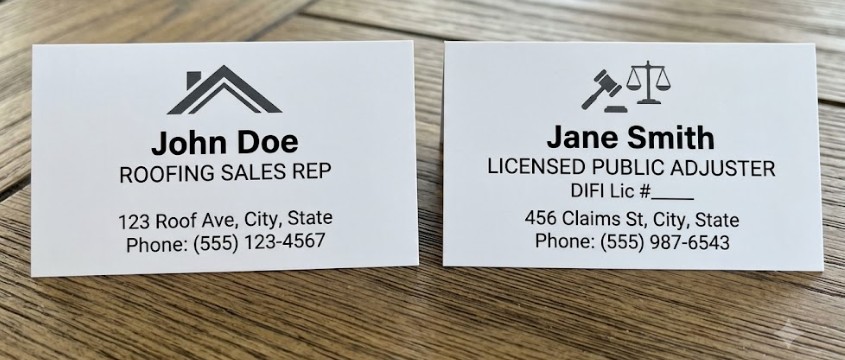
The Roofer Said They Have an “Adjuster on Staff” Is That Legal?
TL;DR
Be skeptical. Arizona requires anyone who adjusts or negotiates claims for homeowners to be individually licensed — and a national ethics standard for public adjusters prohibits adjusting a claim and profiting from the repair on the same loss, because the conflict of interest is obvious. “Adjuster on staff” usually means one of two things: an unlicensed sales rep wearing a borrowed title, or an arrangement where your “advocate” is paid by the company doing your repair. Neither is working for you.
Is it legal for a roofing company to have an adjuster on staff?
An employee of a roofing company generally cannot lawfully act as your public adjuster. Arizona law requires individual licensure to adjust or negotiate claims for an insured — a job title doesn’t confer it, and DIFI enforcement actions show the state pursues unlicensed staff who submit and negotiate claims. Beyond licensure, the conflict is structural: the industry’s own code of ethics bars public adjusters from participating in the repair of a loss they adjusted, because your advocate can’t also be your contractor.
The Details
This is the polished version of the storm-chaser pitch, and it’s designed to sound like the answer to the last article you read. You’ve heard roofers can’t negotiate claims — “but don’t worry, we have an adjuster on staff.”
Pull that thread and here’s what you usually find.
First, the license question. In Arizona, adjuster licensing is individual. Every person who adjusts, investigates, or negotiates claims for an insured — or claims to — needs their own DIFI license. So ask the simple question: “What’s your adjuster license number? I’d like to verify it at difi.az.gov.” Watch what happens. In my experience, the “adjuster on staff” is very often a sales rep with a title, sometimes carrying paperwork drafted around someone else’s credential — pre-signed documents, a letter of representation for a licensed person your rep has never met. Arizona’s insurance regulators have taken enforcement action in cases where unlicensed employees submitted and worked claims under exactly this kind of arrangement.
Second — and this is the part almost nobody tells homeowners — even a genuinely licensed adjuster inside a roofing company has a problem the license can’t fix. The National Association of Public Insurance Adjusters’ code of ethics prohibits a public adjuster from participating in the repair of the same loss they adjusted. Think about why. A public adjuster’s entire value is independence: they work for you and only you. An “adjuster” whose paycheck comes from the roofing company negotiating your settlement is negotiating their own employer’s revenue. That’s not advocacy. That’s sales with a regulatory costume on.
So what does legitimate look like? Two separate professionals with two separate jobs. Your roofing contractor — the craftsman — inspects the roof, produces a photographic damage report, writes an honest repair estimate, stands on the roof with the insurance company’s adjuster, and answers every technical question about what failed and what fixing it correctly requires. That documentation is powerful, it’s lawful, and a good report often resolves a claim without any dispute at all. Then, if your claim is denied, lowballed, or genuinely complex, you separately hire a truly independent public adjuster — licensed by DIFI, verifiable in two minutes, paid by you out of the settlement, with zero connection to whoever repairs the roof.
Independence isn’t a nice-to-have in that arrangement. It’s the entire product.
Disclaimer: We are roofing contractors, not attorneys, and nothing in this article is legal advice. It’s general information based on our reading of publicly available Arizona statutes, DIFI guidance, and industry ethics standards. For legal advice about your specific situation, consult a licensed Arizona attorney.
Key Takeaways
Adjuster licenses are individual — titles don’t count, so ask for the license number and verify it at difi.az.gov. Even a licensed adjuster employed by your contractor has a built-in conflict the industry’s own ethics code prohibits. Your roofer documents and explains; a truly independent PA negotiates. Never accept both services from the same paycheck.
FAQ
How do I check if someone is really a licensed adjuster in Arizona? Ask for their individual license number and verify it through the Arizona Department of Insurance and Financial Institutions at difi.az.gov before they touch your claim.
What if the roofing company’s adjuster really is licensed? The license solves the legal question, not the loyalty question. An adjuster paid by your contractor profits from the repair they’re negotiating. Independent means no financial connection to the construction.
What are pre-signed documents and why do they matter? Paperwork prepared in advance around a credential holder who isn’t actually present or involved — a sign the “representation” is a workaround, not a service. If your rep can’t personally verify their own license, stop.
Want your damage documented by someone with no angle on your claim?
Call The Arizona Roofer (480) 435-5190, www.thearizonaroofer.com. Serving Mesa, Chandler, Gilbert, Queen Creek, San Tan Valley, Tempe, Scottsdale, Apache Junction and the Phoenix valley area.