Here’s the complete Blog #6: Spray Foam vs. Shingles
Spray Foam Roofing vs. Traditional Shingles: Which Is Best for Arizona Homes?
TL;DR
In the Phoenix Valley, choosing between spray foam (SPF) and traditional asphalt shingles depends on roof slope, budget, and energy priorities. Consequently, spray foam excels on flat roofs in Scottsdale, Cave Creek, Paradise Valley, and Fountain Hills—delivering 30% cooling cost reductions and 30-50+ year lifespan with proper maintenance. However, asphalt shingles remain the most affordable upfront option for pitched roofs throughout Mesa, Chandler, Gilbert, Apache Junction, Tempe, and Queen Creek. Moreover, Arizona’s 110°F+ summers and thermal shock (110°F day/60°F night) accelerate shingle degradation 30-40% faster than national averages. Additionally, spray foam’s seamless construction eliminates monsoon leak points entirely. Ultimately, homeowners choosing foam get energy savings, longevity, and superior heat reflection. Conversely, homeowners choosing shingles prioritize aesthetic flexibility and lower initial cost. Therefore, understanding the Arizona-specific performance differences ensures you make the right choice for your property and climate.
UNDERSTANDING ARIZONA’S UNIQUE ROOFING CHALLENGE
Why Arizona Isn’t Like Other States
In the Phoenix Valley, your roof isn’t just a shelter—it’s a thermal shield. With summer temperatures regularly topping 110°F, the “standard” roofing choice can sometimes be the most expensive one in the long run.
Arizona’s roofing environment is unique:
- 300+ days of intense UV radiation annually
- Daily temperature swings of 40-55°F (110°F day / 60°F night)
- Extreme heat acceleration of material degradation
- Low humidity preventing natural drying of moisture
- Desert dust and monsoon debris creating drainage challenges
- Elevation effects amplifying UV intensity
The consequence: Roofing materials that perform adequately in moderate climates often fail 30-40% faster in Arizona. Therefore, understanding how different materials perform in Phoenix Valley conditions is critical to making the right choice.
Reference: EPA: UV Radiation Effects on Materials, NRCA: Cool Roofs
SPRAY FOAM ROOFING (SPF): THE ARIZONA ENERGY CHAMPION
What Is Spray Polyurethane Foam (SPF)?
Spray Polyurethane Foam (SPF) is a liquid that expands into a solid, seamless structure. Moreover, it is widely considered one of the best roof types for energy efficiency in the Valley.
How SPF works:
- Two-part liquid components are sprayed onto the roof deck
- Materials expand and cure into solid foam
- Seamless layer covers entire roof surface (no seams)
- UV-protective topcoat applied for durability and color
- System creates both waterproofing and insulation in one
Why this matters in Arizona: Unlike traditional roofing, SPF combines waterproofing and insulation simultaneously—a critical advantage in our extreme climate.
SPF Advantages: Why Arizona Property Owners Choose Foam
Seamless Protection: Zero Leak Points During Monsoons
Because it’s sprayed, there are zero seams. Moreover, no seams means no leaks during monsoon season.
Traditional roofs fail at:
- Seams between shingles or tiles (water intrusion pathways)
- Flashing transitions (most common leak point)
- Fastener holes (create potential leak points)
- Valleys and transitions (water concentration areas)
SPF eliminates these vulnerabilities:
- Completely seamless membrane
- No fastener holes through waterproofing
- Continuous coverage without interruption
- Water shedding from all directions
- Monsoon rain cannot find entry points
Practical benefit: Notably, SPF roofs have dramatically lower monsoon leak rates compared to traditional roofing. Therefore, homeowners in Scottsdale, Cave Creek, and Paradise Valley choosing foam experience fewer emergency repairs during storm season.
Insulation Powerhouse: Slash Your Cooling Costs
Foam has an incredibly high R-value (typically R-6.5 per inch). Additionally, it stops heat before it enters your attic, which can drop your AC bills by up to 30%.
Energy performance in Arizona heat:
Standard asphalt shingles (no attic insulation):
- Absorb solar heat on roof surface
- Transmit heat through to attic
- Attic reaches 150°F+ in summer
- HVAC system works 30-40% harder
- Annual cooling cost: ~$2,400 (typical home)
Spray foam roof:
- Reflects solar heat (with proper coating)
- Foam insulation value stops conducted heat
- Attic temperature stays 20-30°F cooler
- HVAC system operates normally
- Annual cooling cost: ~$1,700 (typical home)
- Annual savings: $700-1,000+
10-year cooling cost comparison:
- Shingles (cumulative): ~$24,000
- SPF (cumulative): ~$17,000
- Potential savings: $7,000+ over decade
References: U.S. Department of Energy: Cool Roofs, ENERGY STAR: Cool Roofing
Indefinite Lifespan: As Long As You Maintain It
As long as you maintain the protective UV coating, the foam itself can last as long as the house.
SPF lifecycle:
- Foam core itself: 50-60+ years
- UV protective coating: 10-15 years (requires recoating)
- With maintenance: 30-50+ years realistic
- Some well-maintained systems: 40+ years documented
Why this matters:
- One-time installation provides decades of protection
- Recoating costs far less than roof replacement
- No need for complete roof removal/replacement
- Environmentally friendly (diverts waste from landfills)
Comparison:
- Asphalt shingles: Typically 15-25 years (shorter in Arizona due to heat/UV)
- SPF with maintenance: 30-50+ years
- Longevity advantage: 15-25 years additional life
SPF Disadvantages: Real Limitations to Consider
Slope Requirements: Not Suitable for Pitched Roofs
Foam is specifically designed for flat or very low-slope roofs (under 3:12 pitch).
Why pitch matters:
- SPF needs to be applied in liquid form
- Gravity causes liquid to run off steep slopes
- Proper adhesion requires minimal angle
- Steep roofs require shingles or tiles for drainage
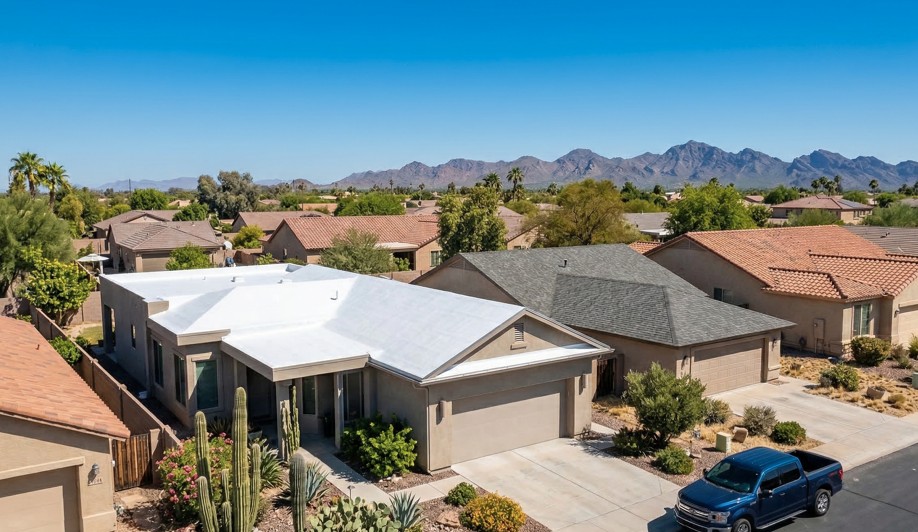
Arizona implications: Notably, most residential homes in Scottsdale, Fountain Hills, and Paradise Valley have pitched roofs—making SPF unsuitable for these properties. However, flat-roof Mid-Century Modern and Santa Fe style homes are ideal SPF candidates.
Weather Application Restrictions: Limited Installation Windows
SPF requires specific weather conditions for proper application.
Application requirements:
- Temperature: 50-85°F (not extreme heat or cold)
- Humidity: Below 85%
- No rain: 24-48 hours after application
- No wind: <15 mph during application
Arizona challenge: During summer (best roofing season), temperatures exceed 85°F most days. Therefore, spring (March-May) and fall (October-November) provide optimal installation windows. Consequently, scheduling can be delayed, extending project timelines.
Bird Damage: Rare But Possible
In rare cases, local birds might peck at the foam if the top coating isn’t thick enough.
Reality check:
- Occurs in fewer than 5% of installations
- Happens only if topcoat is inadequate
- Easily repaired with spot touch-ups
- Preventable with proper specification and application
Mitigation: Ensure contractor applies adequate topcoat thickness (typically 0.5-1.5 mils for UV protection).
ASPHALT SHINGLES: THE TRADITIONAL STANDARD
Understanding Asphalt Shingles in Arizona
Shingles are the most common roofing material in America. Moreover, they are versatile, aesthetic, and budget-friendly. However, Arizona’s climate presents unique challenges for this traditional material.
How asphalt shingles work:
- Individual overlapping shingles create water-shedding barrier
- Granule coating provides UV protection and color
- Felt or fiberglass base provides structure
- Nails or adhesive secure shingles to roof deck
- Valleys and transitions direct water flow
Shingle Advantages: Why Homeowners Still Choose Them
Versatility: Works on Almost Any Pitched Roof
They work on almost any pitched roof and come in dozens of styles to match HOA requirements.
Architectural flexibility:
- Works on steep slopes (better than flat roofs)
- Comes in multiple colors and textures
- Architectural styles available (mimic higher-end materials)
- Fits HOA requirements across East Valley communities
- Traditional aesthetic appeals to many homeowners
East Valley applicability: Notably, most residential homes in Mesa, Chandler, Gilbert, Apache Junction, Tempe, and Queen Creek have pitched roofs—making shingles the natural choice for these properties.
Easy Repairs: Quick Fixes When Needed
If a few shingles blow off during a dust storm, they are cheap and fast to replace.
Repair advantages:
- Individual shingles can be replaced (don’t need full roof)
- Repair materials widely available
- Installation straightforward
- Cost per repair low ($50-300 per shingle replacement)
- Temporary fixes possible (until full repair)
Arizona-specific benefit: Wind events and dust storms frequently damage individual shingles. Moreover, easy repairs keep homeowners from major expenses.
Lower Initial Cost: Budget-Friendly Installation
Shingles are the most affordable way to get a high-quality roof installed quickly.
Cost comparison (typical 2,000 sq. ft. house):
- Asphalt shingles: $8,000-15,000
- Metal shingles: $15,000-25,000
- Spray foam: $15,000-22,000
- Tile: $25,000-40,000+
Why upfront cost matters:
- Lower barrier to roof replacement
- Budget predictability for homeowners
- Financing easier for lower amounts
- Financial accessibility for middle-income homeowners
First-cost advantage: Notably, asphalt shingles remain the entry-level roofing choice, making them attractive to cost-conscious homeowners across the East Valley.
Shingle Disadvantages: Arizona-Specific Challenges
The “Oven” Effect: Heat Absorption in Desert Climate
Standard shingles absorb heat. Moreover, without a high-end reflective granule, your attic can reach 150°F+, forcing your AC to work overtime.
What happens:
- Black or dark shingles absorb 80-90% of solar radiation
- Surface temperature reaches 150-170°F in Arizona summer
- Heat conducts through shingles to decking
- Attic temperature reaches 150°F+ on hot days
- HVAC system runs 30-40% harder than necessary
Energy cost impact:
- Increased cooling costs: $800-1,200 annually
- Accelerated HVAC equipment wear
- Reduced air conditioning efficiency
- Higher electricity consumption during peak hours
Solution available: Reflective granule technology can reduce surface temperature 20-30°F. However, these premium shingles cost 20-30% more than standard options.
Thermal Shock: Rapid Heating and Cooling
The rapid heating and cooling of the desert (110°F day / 60°F night) causes shingles to crack, curl, and lose granules faster than in other climates.
How thermal shock damages shingles:
Summer days (110°F+):
- Shingles expand with extreme heat
- Materials become flexible and soft
- UV rays intensify granule degradation
- Sealants and adhesives weaken
Nighttime cooling (60°F):
- Shingles contract rapidly
- Materials become brittle
- Fasteners loosen through cycling
- Stress cracks form at weak points
Repeat 150+ times per summer:
- Cumulative stress damages accumulate
- Granules begin lifting and loss
- Cracks develop at valley points
- Curling and cupping becomes visible
- Premature aging accelerates
Arizona impact: Notably, thermal shock reduces asphalt shingle lifespan 30-40% in Arizona compared to moderate climates. Consequently, what lasts 25 years nationally might only last 15-18 years in Phoenix Valley.
Granule Loss: The Visible Sign of Deterioration
As UV radiation degrades shingles, protective granules wash away. Moreover, finding excessive granules in gutters signals accelerated aging.
What granule loss means:
- Underlying asphalt exposed to UV
- Aging process accelerates rapidly once granules are gone
- Water resistance deteriorates
- Lifespan shortens by 50%+ once visible loss occurs
Timeline:
- Year 1-3: Normal minimal granule loss
- Year 4-6: Increased granule loss (Arizona heat)
- Year 7-10: Significant visible loss
- Year 10-15: Roof near end-of-life
Early warning: Notably, finding granules in gutters indicates shingles have entered accelerated aging phase. Therefore, this signals it’s time to budget for replacement within 5-10 years.
DETAILED COMPARISON: SPRAY FOAM VS. SHINGLES
Performance Comparison Table
| Feature | Spray Foam (SPF) | Asphalt Shingles | Winner for Arizona |
|---|---|---|---|
| Best For | Flat roofs | Pitched roofs | Depends on slope |
| Insulation Value | Excellent (R-6.5/in) | Minimal (needs attic insulation) | SPF |
| Lifespan | 30-50+ years (with recoats) | 15-25 years (shorter in AZ) | SPF |
| Maintenance | Recoat every 5-10 years | Occasional replacement | Shingles (less frequent) |
| Upfront Cost | Moderate-High ($15-22k) | Low-Moderate ($8-15k) | Shingles |
| Cooling Cost Reduction | 25-30% | 0% (without special shingles) | SPF |
| Monsoon Leak Risk | Very low (seamless) | Moderate-High (seams/flashing) | SPF |
| Thermal Shock Resistance | Good (no granules) | Poor (accelerated by cycles) | SPF |
| Repair Cost | Higher per repair | Lower per repair | Shingles |
| Aesthetic Options | Limited (color options) | Many styles/colors | Shingles |
| Installation Difficulty | Moderate-High (requires skill) | Lower (more contractors) | Shingles |
| Environmental Impact | Good (long life, less waste) | Moderate (regular replacement) | SPF |
THE VERDICT: WHICH SHOULD YOU CHOOSE?
Choose Spray Foam If:
✓ You have a flat-roof home (like a Mid-Century Modern or Santa Fe style)
✓ Slashing your electric bill is a priority (30% savings potential)
✓ You’re concerned about monsoon leaks (seamless means no seams)
✓ You plan to stay 20+ years (longevity advantages compound)
✓ Energy efficiency matters (LEED, green building credits)
✓ You want maximum protection (one-time installation for decades)
✓ You’re in Scottsdale, Cave Creek, or Paradise Valley with flat-roof design
SPF is ideal for: Commercial buildings, modern residential designs, energy-conscious homeowners, long-term investment planning.
Choose Asphalt Shingles If:
✓ You have a pitched roof (most East Valley homes)
✓ You want the lowest upfront investment (budget-friendly)
✓ Your HOA requires traditional aesthetics (many style options)
✓ Quick repair matters (individual shingles replaceable)
✓ You may move within 10-15 years (upfront cost recovery focus)
✓ Widespread contractor availability matters (easy to find installers)
✓ Aesthetic variety is important (dozens of color/texture options)
Shingles are ideal for: Traditional pitched roofs, cost-conscious homeowners, Mesa, Chandler, Gilbert, Apache Junction, Tempe, Queen Creek residences, HOA communities.
The Hybrid Approach: Premium Shingles
Consider architectural or premium shingles if:
- You have a pitched roof (shingles required)
- You want better performance than standard shingles
- You’re willing to invest 20-30% more upfront
Premium shingle advantages:
- Reflective granules reduce heat absorption 20-30°F
- Better wind resistance (up to 130+ mph)
- Enhanced UV protection (longer lifespan)
- Warranty coverage often 25-30 years
- Better aesthetic options
Cost: $12,000-18,000 (vs. $8,000-15,000 for standard)
Lifespan: 20-30 years (vs. 15-25 years for standard)
ROI: Energy savings + extended life often justify premium pricing
ARIZONA-SPECIFIC INSTALLATION CONSIDERATIONS
Timing: When to Install in Phoenix Valley
Optimal installation windows:
Spring (March-May):
- Temperature: 65-80°F (ideal for all materials)
- SPF ideal curing conditions
- Shingle installation perfect weather
- Contractor availability moderate
- Best season overall
Fall (October-November):
- Temperature: 75-85°F (acceptable)
- Humidity: Moderate (good for application)
- SPF can be installed (near upper limit)
- Shingle installation ideal
- Contractor availability better (post-summer)
Summer (June-August):
- Temperature: 105-120°F (too hot for SPF)
- Early morning installation possible (before 9 AM)
- Shingle installation possible but stressful
- Warranty restrictions may apply
- Contractor availability highest (demand)
- Least ideal conditions
Winter (December-February):
- Temperature: 50-65°F (acceptable to cool)
- SPF problematic (near lower limits)
- Shingle installation acceptable
- Contractor availability lowest
- Pricing may be better
- Secondary option
UV Coating Importance for Arizona
For SPF roofs specifically:
The UV protective topcoat is critical in Arizona’s 300+ days of intense sun.
Topcoat specifications:
- Aliphatic polyol polyurethane (best UV resistance)
- Minimum 0.5-1.5 mil thickness
- Reflectivity: 70-85% (reduces heat absorption)
- Color stability: Maintains color/reflectivity for 10-15 years
- Recoating interval: Every 5-10 years (Arizona = shorter interval)
Why topcoat matters: Without proper UV protection, SPF foam degrades rapidly. Moreover, topcoat replacement costs $0.50-1.00/sq. ft. vs. full roof replacement at $8-25/sq. ft.
COST ANALYSIS: TOTAL COST OF OWNERSHIP
30-Year Total Cost Comparison
Scenario: Typical 2,000 sq. ft. flat-roof home in Scottsdale/Paradise Valley
Option 1: Standard Asphalt Shingles
| Item | Cost | Timeline |
|---|---|---|
| Initial installation | $10,000 | Year 0 |
| Replacement #1 | $10,000 | Year 15 |
| Replacement #2 | $11,000 | Year 30 |
| Cumulative repairs | $2,000 | Years 1-30 |
| Cooling costs (annual avg: $2,200) | $66,000 | Years 1-30 |
| Total 30-year cost | $99,000 |
Option 2: Spray Foam with Maintenance
| Item | Cost | Timeline |
|---|---|---|
| Initial installation | $18,000 | Year 0 |
| Recoat #1 | $2,000 | Year 10 |
| Recoat #2 | $2,000 | Year 20 |
| Maintenance/repairs | $1,500 | Years 1-30 |
| Cooling costs (annual avg: $1,600) | $48,000 | Years 1-30 |
| Total 30-year cost | $71,500 |
Comparison
- Shingles total 30-year cost: $99,000
- SPF total 30-year cost: $71,500
- SPF savings: $27,500 over 30 years
- Average annual savings: $917/year
Important note: Energy savings compound significantly over time. Moreover, this doesn’t account for potential second replacement of shingles around year 25-27 if lifespan shortened by Arizona heat.
COMMON QUESTIONS: SPRAY FOAM VS. SHINGLES
Q: Can you apply spray foam to a pitched roof?
A: Technically possible for low-slope roofs (under 3:12 pitch), but not recommended for steep pitches. Therefore, most pitched homes require shingles.
Why pitch matters in Arizona:
- SPF is liquid during application
- Gravity causes flow off steep slopes
- Adhesion requires nearly level surface
- Maintenance and recoating harder on steep slopes
Exception: Very low-slope roofs (2:12 or less) can accommodate SPF. However, typical residential homes in Mesa, Chandler, Gilbert have steeper pitches—requiring shingles.
Q: How often do I need to maintain an SPF roof?
A: The foam itself requires minimal maintenance. However, the UV protective topcoat needs recoating every 5-10 years in Arizona.
Maintenance timeline:
- Annual: Inspect for damage, clear debris
- Every 2 years: Thermal imaging inspection
- Every 5-10 years: Topcoat recoat (Arizona climate = 5-year interval recommended)
- As needed: Repair punctures, seal cracks
Cost: Recoating typically costs $1-2/sq. ft. (vs. $8-15/sq. ft. for shingle replacement). Therefore, maintenance is significantly cheaper than replacement.
Q: Do reflective shingles really save energy in Arizona?
A: Yes, but the savings are modest compared to SPF. Reflective shingles reduce cooling costs 10-15% (vs. 25-30% for SPF).
Why the difference:
- Reflective shingles reduce surface temperature 20-30°F
- Foam insulation stops conducted heat entirely
- Combined effect (reflection + insulation) is SPF advantage
ROI on premium shingles:
- Additional cost: $2,000-5,000 (20-30% premium)
- Annual cooling savings: $200-300
- Payback period: 7-15 years
- Positive ROI but slower than SPF
Q: What’s the warranty difference between SPF and shingles?
A: Warranty terms vary significantly by product and contractor.
Typical warranties:
Shingles:
- Manufacturer: 25-30 years (prorated)
- Labor/workmanship: 5-10 years
- Arizona-specific: Often voided if roof not properly ventilated
SPF:
- Foam: 25-30 years (with proper topcoat)
- Topcoat: 10-15 years
- Labor/workmanship: 10-20 years (contractor-dependent)
Important: Moreover, Arizona’s extreme climate may void manufacturer warranties if installation doesn’t meet specifications. Therefore, verify warranty coverage before installation.
Q: How does hail damage affect each type?
A: Shingles show visible dents/damage easily. SPF is more resilient but can be punctured.
Hail performance:
Shingles:
- Class 4 (highest) rating resists large hail
- Impact creates visible damage
- Easy to photograph for insurance claims
- Individual shingles replaceable
SPF:
- Resilient but puncturable with large hail
- Damage not always visible
- Requires professional assessment
- Repair involves spot patches or recoating
Arizona note: Notably, large hail is rare in Phoenix Valley (elevation and geography provide protection). However, during rare hail events, East Valley communities in higher elevations (Paradise Valley, Fountain Hills) are more vulnerable.
Q: Which is better for the environment?
A: SPF wins on environmental metrics.
Environmental comparison:
Shingles:
- Replaced every 15-25 years
- Landfill waste: ~10,000+ lbs per roof
- Repeated manufacturing/transportation
- 30-year impact: 2+ replacements = significant waste
SPF:
- One installation provides 30-50+ years
- Minimal replacement over lifespan
- Recoating diverts waste (vs. replacement)
- 30-year impact: Single installation + maintenance
- 30-50% less material waste
References: EPA: Sustainable Materials Management, NRCA: Green Roofing
Q: Can I apply SPF over existing shingles?
A: Generally not recommended, though possible in limited situations.
Why existing shingles problematic:
- Uneven surface doesn’t provide stable base
- Movement of shingles creates stress on foam
- Moisture trapped under shingles can cause problems
- Most manufacturers recommend removal first
Cost consideration:
- Removal: $1-2/sq. ft.
- Installation: $7-11/sq. ft.
- Total typically less than replacement with new shingles
Therefore, if converting to SPF, plan for old shingle removal as part of project.
PROTECTING YOUR INVESTMENT: CONTRACTOR SELECTION
What The Arizona Roofer Provides
✓ Licensed Arizona contractor (ROC #352286 & #359801)
✓ 40+ years Arizona experience (climate-specific expertise)
✓ $30,000 deposit protection (third-party guarantee)
✓ $250,000 workmanship warranty (Directorii certified)
✓ Written detailed assessment (no guessing)
✓ Thermal imaging inspection (detects hidden damage)
✓ Honest recommendations (restoration vs. replacement based on actual condition)
✓ Flexible financing (low monthly payment plans)
✓ Transparent pricing (no hidden costs)
✓ Post-installation support (seasonal maintenance plans)
What We Don’t Do
❌ Push unnecessary upgrades — we recommend what makes sense
❌ Rush installation — proper timing matters in Arizona
❌ Skip detailed inspection — every assessment is thorough
❌ Use unverified materials — Arizona-rated products only
❌ Guarantee results without specifications — we document everything
❌ Ignore maintenance — we provide long-term guidance
MAKING YOUR DECISION: STEP-BY-STEP GUIDE
Step 1: Assess Your Roof Slope
Measure your roof pitch:
- Get roof plans from builder or county records
- OR measure rise over 12 inches of run
- Consult a roofer if unsure
Decision:
- Under 3:12 pitch → SPF possible
- Over 3:12 pitch → Shingles required
Step 2: Calculate 30-Year Total Cost
Gather information:
- Current cooling costs (look at utilities)
- Local installation costs (get quotes)
- Contractor warranty terms
- Energy efficiency goals
Use comparison table above to calculate your specific scenario.
Step 3: Consider Your Timeline
Ask yourself:
- Am I staying 20+ years? (SPF advantage)
- Do I need lowest upfront cost? (Shingle advantage)
- Is energy efficiency a priority? (SPF advantage)
- Does aesthetics matter? (Shingle advantage)
Step 4: Get Multiple Professional Assessments
Don’t choose based on this article alone:
- Contact 3+ licensed Arizona contractors
- Ask for written assessments
- Compare recommendations
- Verify contractor licensing (Arizona ROC)
- Check references and reviews
Step 5: Make Your Decision
Based on:
- Roof slope (determines feasibility)
- Total cost of ownership (30-year comparison)
- Energy priorities (savings potential)
- Timeline (how long you’ll stay)
- Aesthetic preferences (HOA requirements)
NEXT STEPS: GET A PROFESSIONAL ASSESSMENT
Don’t guess about which roofing system is right for your Arizona home. Moreover, professional assessment from a climate-expert contractor ensures you make the right choice.
Get a detailed written evaluation:
📞 Call The Arizona Roofer: (480) 435-5190
📱 Text: (480) 435-5190
📧 Email: thearizonaroofer@gmail.com
🌐 Website: www.thearizonaroofer.com
What you’ll receive:
✓ Complete roof assessment with photos
✓ Slope verification and suitability analysis
✓ Material recommendations for your specific needs
✓ 30-year cost of ownership comparison
✓ Energy savings projection (if applicable)
✓ Written warranty and guarantee terms
✓ Financing options review
✓ Maintenance plan for long-term protection
We serve the entire East Valley:
Scottsdale • Cave Creek • Paradise Valley • Fountain Hills • Mesa • Chandler • Gilbert • Apache Junction • Tempe • Queen Creek
Licensed, Bonded, Insured:
ROC #352286 & #359801 | 40+ Years Arizona Experience | Directorii Certified
Financing Available:
- Low monthly payment plans
- $30,000 deposit protection
- $250,000 workmanship warranty
- Section 179 tax deductions (commercial)
Why Choose The Arizona Roofer:
Unlike other contractors, we don’t push unnecessary upgrades or rush you into decisions. Moreover, we provide transparent pricing, written guarantees, and Arizona-specific expertise. Furthermore, our third-party deposit protection and workmanship warranty mean your investment is genuinely safe.
KEY TAKEAWAYS
✓ Spray foam excels on flat roofs with 30% cooling cost reductions and 30-50 year lifespan
✓ Asphalt shingles work on pitched roofs with lower upfront cost and aesthetic flexibility
✓ Arizona’s heat accelerates shingle aging 30-40% compared to national averages
✓ SPF seamless design eliminates monsoon leak points — no seams means no vulnerabilities
✓ Thermal shock (110°F day/60°F night) degrades shingles faster than traditional climates
✓ 30-year total cost comparison matters more than upfront price — SPF often wins despite higher initial investment
✓ Professional assessment is essential — don’t make this decision alone
✓ Maintenance plans extend roof life dramatically — both SPF and shingles need proper care
✓ Energy efficiency translates to savings — reflective coatings and insulation pay dividends over time
✓ Licensed Arizona contractors make the difference — climate expertise prevents costly mistakes