-
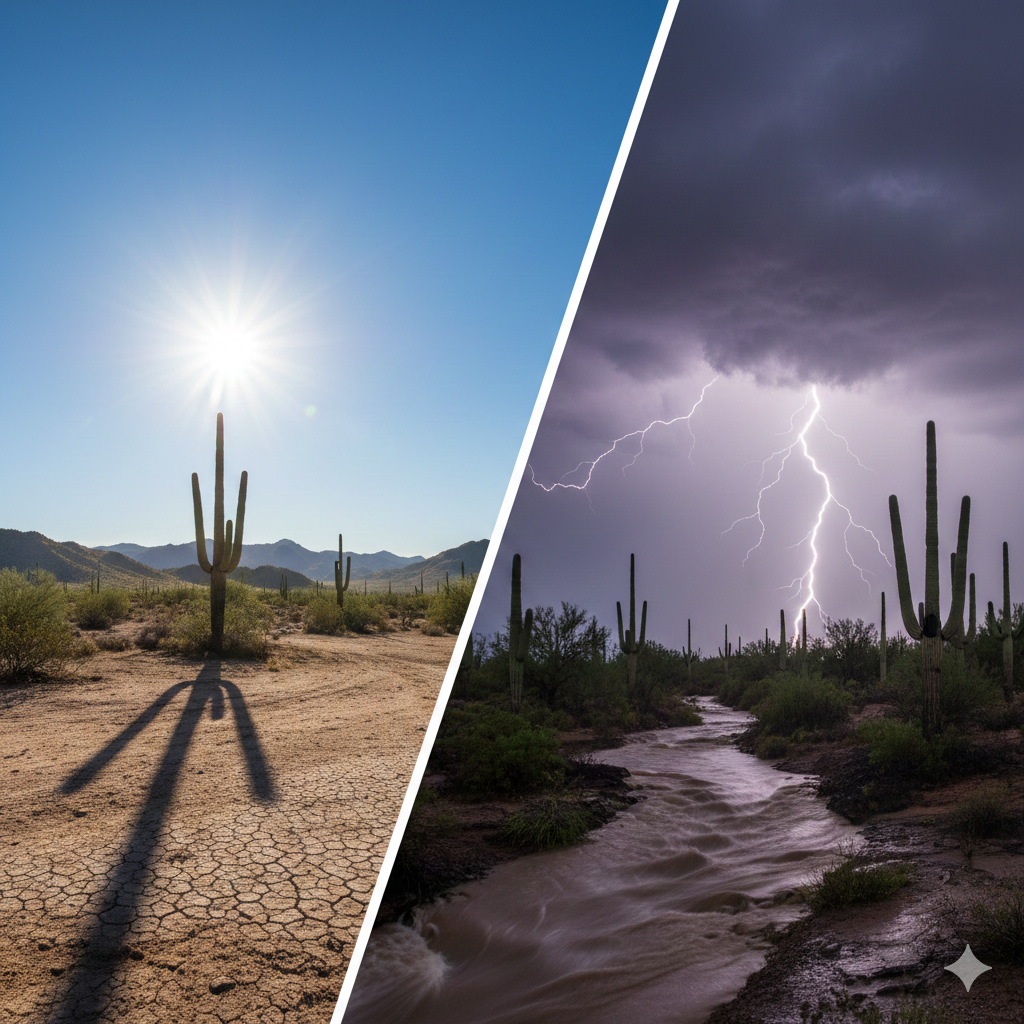
📖 BLOG #4: Arizona Sun Is More Dangerous Than a Monsoon
TL;DR
Arizona’s sun—not monsoons—is the primary threat to your roof. Consequently, the sun damages roofs in Scottsdale, Cave Creek, Paradise Valley, Fountain Hills, Mesa, Chandler, Gilbert, Apache Junction, Tempe, and Queen Creek through constant UV degradation and thermal shock (expansion/contraction). However, monsoons merely reveal damage the sun has been creating for months. Moreover, residential tile roofs develop brittle underlayment; commercial flat roofs develop micro-fractures and chalking. By the time a monsoon hits and water appears inside, structural damage is already advanced. Additionally, professional inspections every 2-3 years catch sun damage before it becomes expensive. Furthermore, UV-reflective coatings on commercial roofs reduce damage progression 50%+ while cutting cooling costs 10-15%. Homeowners with tile roofs need underlayment inspection every 5 years. Ultimately, the Arizona sun creates 300+ days of constant pressure on roofing materials—far more damaging than the few days a year it actually rains.
WHY THE SUN IS YOUR ROOF’S REAL ENEMY
The Great Arizona Misconception
Arizona residents have it backwards. We fear the monsoon. Additionally, we watch the news for haboobs. Furthermore, we check ceilings when sirens go off.
But after 40+ years of professional roofing observation across Scottsdale, Cave Creek, Paradise Valley, Fountain Hills, and throughout the East Valley, I can tell you this with certainty:
The most dangerous day for your roof isn’t the day it rains. Instead, it’s every single sunny day in between.
The Difference: Water vs. Damage
In other states, water causes roof failure through rot and mold. By contrast, in Arizona, water is just the messenger.
The real killer is UV radiation and thermal shock occurring 300+ days per year. Consequently, by the time a heavy monsoon hits your Scottsdale or Gilbert home, the sun has already spent months—or years—making your roof brittle, cracked, and defenseless.
When the rain finally comes, it doesn’t create damage. Instead, it reveals the deterioration that was already there.
This is the critical distinction most homeowners and property managers miss. Therefore, you’re not protecting against one big storm. Rather, you’re protecting against constant, invisible, daily assault.
HOW THE SUN DESTROYS YOUR ROOF
Threat #1: UV Degradation — The Chemical Breakdown
Think of your roof like your skin exposed to Phoenix sun for 10 hours every day without protection. Notably, your roof is literally experiencing exactly that.
For residential homes in Scottsdale and Paradise Valley:
UV rays bake the essential oils out of asphalt shingles and the underlayment beneath your tiles. Consequently, this causes them to lose flexibility and elasticity.
What happens:
- Materials become brittle and inflexible
- They crack at the slightest stress (wind, vibration, thermal expansion)
- Cracks are invisible from ground level
- Water finds these hairline fractures during the first rain
Why Arizona is worse:
- 300+ days of intense UV radiation per year
- Elevation near 1,100 feet means stronger UV intensity
- Desert atmosphere has less cloud cover to filter UV
- Summer sun angle creates maximum UV exposure on south and west-facing slopes
The timeline: Notably, a residential roof’s underlayment can go from flexible to brittle in 5-7 years of Arizona sun exposure.
For commercial buildings in Mesa, Chandler, and the East Valley:
On flat or low-slope roofs, the sun breaks down the molecular bonds of coatings and membranes. Consequently, this leads to:
- Chalking: White powdery residue on roof surface (sign of coating breakdown)
- Microscopic fractures: Too small to see but large enough to let moisture through
- Loss of reflectivity: Coating stops reflecting UV, accelerating further degradation
- Membrane embrittlement: Material becomes stiff and cracks under stress
The cost impact: A flat roof coating that should last 15 years might only last 8-10 years in Arizona because of accelerated UV degradation.
Threat #2: Thermal Shock — The Daily Expansion and Contraction
Arizona has some of the most extreme daily temperature swings in the country. Moreover, this creates immense stress on roofing materials.
A typical Arizona summer day:
- Peak afternoon temperature: 115-120°F on roof surface
- Night temperature: 65-75°F
- Daily swing: 40-55°F+ temperature change
This happens 150+ days annually.
This constant “breathing” creates immense mechanical stress on every component:
- Seams expand and contract differently than the material itself
- Nails loosen gradually through thermal cycling
- Flashing points separate slightly with each cycle
- Sealants crack from repeated expansion/contraction
What happens:
- Day 1: Roof expands in 115°F heat
- Night 1: Roof contracts in 75°F cool
- Day 2: Expansion again (slightly different stress points)
- Repeat 150+ times per summer
Importantly, this creates stress fractures so small you can’t see them. Nevertheless, they’re there, expanding and contracting daily, waiting for water to find them.
The hidden damage: These micro-fractures develop gradually. Notably, you won’t notice them during dry June. However, in August, when a monsoon drops 2 inches of rain in 1 hour, those tiny cracks become major interior leaks.
RESIDENTIAL ROOFS: THE TILE ROOF TRAP
Why Tile Roofs Fail in Arizona
Tile roofs are beautiful. Additionally, they’re durable. Moreover, they can last 50+ years in the right climate.
Notably, Arizona isn’t the right climate.
The misconception: “My tile roof looks perfect from the street, so it’s fine.”
The reality: Interestingly, tiles are just armor. They aren’t what keeps the water out. Instead, the underlayment underneath does the heavy lifting.
The Underlayment Problem
Under your tile roof sits a layer of underlayment (typically synthetic material or felt) that:
- Catches water that penetrates between tiles
- Directs water toward gutters and drains
- Provides the actual waterproof seal
In Arizona’s sun, this underlayment doesn’t slowly fade. Rather, it degrades aggressively:
Year 1-3: Material remains flexible, performs normally
Year 4-6: UV exposure begins breaking down synthetic fibers
- Becomes stiff and brittle
- Loses flexibility around penetrations
- Cracks begin forming in corners and valleys
Year 7-10: Material becomes “potato chips”
- Cracks everywhere
- No longer flexible
- Loses ability to channel water
- “Crumbles” when pressure is applied
Year 10+: Complete failure risk
- Material deteriorates to dust
- Any water penetrating tiles goes directly inside
- Structural damage accelerates rapidly
The Solution: Tile Lift and Lay
This is why we specialize in “Tile Lift and Lay” restoration:
- Carefully remove tiles (preserve original aesthetic)
- Remove deteriorated underlayment (get to the root problem)
- Install new, heat-resistant underlayment (designed for Arizona conditions)
- Replace tiles (maintains original character and value)
- Add UV-protective elements (reduces future sun damage)
Result: Original tile preserved, waterproofing renewed
Cost: $6-12 per sq. ft.
Lifespan: 20-30 years with maintenance
COMMERCIAL ROOFS: THE FLAT ROOF DILEMMA
Why Commercial Flat Roofs Fail
Commercial property managers face a different problem. Notably, flat or low-slope roofs take direct sun exposure 24/7 in Arizona.
The challenge:
- Coatings and membranes are designed for moderate climates
- Arizona heat accelerates degradation 2-3x faster
- Even “Arizona-rated” materials degrade faster than expected
- Property managers often don’t realize the rate of deterioration
The Degradation Timeline
Year 1-2: Coating looks good, performs to spec
Year 3-5:
- Chalking begins (white powdery residue)
- Reflectivity starts declining
- First micro-fractures appear
Year 5-8:
- Significant chalking visible
- Reflectivity down 30-50%
- Multiple sealant failures
Year 8-12:
- Coating severely compromised
- Reflectivity down 70%+
- Multiple active leak points
- Building interior temperature rising
- Cooling costs increasing 15-20%
The Energy Cost Impact
Here’s the financial piece most commercial property managers overlook:
A flat roof with failing coating:
- Reflectivity drops from 80% to 20-30%
- Building absorbs far more heat
- Cooling system works 15-20% harder
- Annual cooling costs increase significantly
Annual cooling cost increase on 10,000 sq. ft. commercial building:
- Modern cooling system: ~$0.12 per sq. ft. per year
- Degraded roof: +$0.18-0.24 per sq. ft. per year
- Additional annual cost: $600-1,200+
Over 10 years, that’s $6,000-12,000+ in excess cooling costs—while the roof is also deteriorating and becoming a leak risk.
The Solution: UV-Reflective Coating Restoration
Instead of replacement:
- Apply UV-reflective coating system
- Restore reflectivity to 80%+
- Stop micro-fracture progression
- Reduce cooling costs 10-15% immediately
- Extend roof life 10-20 years
Cost: $5-12 per sq. ft. (vs. $15-25 for replacement)
ROI: Energy savings + extended life often exceeds cost within 5-7 yearsReference: NRCA: Commercial Roof Coatings & Energy Efficiency
SPOTTING SUN DAMAGE BEFORE IT’S EXPENSIVE
Visual Signs of UV Degradation
On residential roofs:
- Granule loss on asphalt shingles (white streaks or bare spots)
- “Cupping” or “curling” on shingle edges
- Color fading or streaking
- Sealant around vents cracking or missing
- Tiles appearing dull or chalky (on tile roofs)
On commercial flat roofs:
- White powdery residue (chalking)
- Color fading or streaking
- Surface cracking or alligatoring pattern
- Sealant failure around penetrations
- Water pooling in new locations (signs of slope change from UV warping)
Interior signs (any roof type):
- Water stains on ceilings (even small ones)
- Damp spots in attic or crawlspace
- Musty odors (early mold development)
- Paint bubbling or peeling on interior walls
- Insulation visible discoloration
INSPECTION INTERVALS
Recommended Inspection Schedule
Residential homes (Scottsdale, Paradise Valley, Fountain Hills):
- Tile roofs: Every 5 years (underlayment is critical)
- Asphalt/composition shingles: Every 3-5 years
- After major storms: Within 48 hours
Commercial properties (Mesa, Chandler, Gilbert, Apache Junction):
- Flat roofs with coatings: Every 2 years
- Flat roofs with membranes: Every 2-3 years
- Post-monsoon: Routine inspection
Both residential and commercial:
- Immediately after wind events >40 mph
- Immediately after significant hail
- When you notice any of the visual signs above
The ROI of Regular Inspection
Cost of annual inspection: $400-800
Cost of emergency repair: $5,000-15,000+
Cost of premature roof replacement: $80,000-250,000+Inspection ROI: Every inspection prevents 10-20x its cost in emergency repairs through early detection.
COMMON QUESTIONS ABOUT SUN DAMAGE
Q: My roof looks fine from the ground. Do I really need an inspection?
A: Visual inspection catches maybe 20% of sun damage. The real damage includes:
- Underlayment degradation (you can’t see it without lifting tiles)
- Micro-fractures in coatings (invisible without close inspection)
- Sealant failure around penetrations (hard to spot from below)
- Wet insulation (requires thermal imaging to detect)
A professional inspection is the only way to know the actual condition.
Q: If my roof isn’t leaking, does it need work?
A: This is the #1 mistake Arizona property owners make. By the time water appears inside, damage is advanced. Therefore, waiting creates problems:
- Insulation is already saturated
- Structural wood may be rotting
- Mold may already be developing
- Damage is 10x more expensive to fix
Smart approach: Inspect regularly. Fix small problems before they become big ones.
Q: Can I slow down sun damage?
A: Yes, partially:
For residential roofs:
- Trim overhanging trees (provides shade)
- Install UV-protective coatings (extend shingle life 2-3 years)
- Improve attic ventilation (reduces heat buildup)
- Annual inspections (catch problems early)
For commercial roofs:
- Apply UV-reflective coating (extends life 5-10 years + reduces energy costs)
- Increase inspection frequency (catch damage early)
- Improve drainage (prevents ponding that accelerates degradation)
- Implement maintenance program (sealant touch-ups, debris removal)
Reality: You can’t stop sun damage, but you can slow it significantly with proper maintenance.
THE ARIZONA ROOFER APPROACH
Why Sun Damage Requires Arizona-Specific Expertise
I’ve been assessing roofs across Scottsdale, Cave Creek, Paradise Valley, Fountain Hills, Mesa, Chandler, Gilbert, Apache Junction, Tempe, and Queen Creek for 40+ years. Notably, I’m a former Registered Roof Observer (RRO) and NRCA Subject Matter Expert. Furthermore, I’ve seen thousands of roofs fail—and I can tell you that contractors without Arizona climate expertise miss critical sun damage.
The difference: Arizona contractors understand that the sun is the primary threat, not monsoons. Conversely, out-of-state contractors still think like their home climate where water is the main enemy.
What We Do
✓ Identify sun damage before it becomes expensive
✓ Thermal imaging to detect moisture from UV failures
✓ Condition assessments that focus on Arizona-specific threats
✓ Preservation options (tile lift and lay, coating restoration)
✓ Energy efficiency solutions (reflective coatings reduce cooling costs)
✓ Written documentation for insurance and warranty purposes
✓ Maintenance plans to extend roof life with the Arizona climate in mind
✓ Honest recommendations (restoration vs. replacement based on actual condition)What We Don’t Do
❌ Rush you into replacement when restoration makes sense
❌ Recommend one-size-fits-all solutions for Arizona
❌ Use materials not designed for Arizona heat and UV
❌ Skip inspection or guess at conditions
❌ Push unnecessary work or emergency pricing
❌ Ignore the sun damage that’s the real threat
NEXT STEPS: PROTECT YOUR PROPERTY
Don’t wait for a leak to tell you that Arizona sun has damaged your roof. Notably, by the time you see water inside, structural damage is already advanced. Therefore, action now prevents expensive repairs later.
Get a professional evaluation focused on sun damage:
📞 Call The Arizona Roofer: (480) 435-5190
📱 Text: (480) 435-5190
📧 Email: thearizonaroofer@gmail.com
🌐 Website: www.thearizonaroofer.comWhat we provide:
✓ Comprehensive inspection with thermal imaging
✓ Sun damage assessment for Arizona climate
✓ Honest restoration vs. replacement recommendation
✓ Written report with photos and findings
✓ Maintenance plan to extend roof life
✓ Energy efficiency analysis (commercial)
✓ Warranty documentation and supportWe serve the entire East Valley:
Scottsdale • Cave Creek • Paradise Valley • Fountain Hills • Mesa • Chandler • Gilbert • Apache Junction • Tempe • Queen CreekLicensed, Bonded, Insured:
ROC#352286񗵹| 40+ Years Arizona Experience