WHAT TO DO IN THE FIRST 72 HOURS AFTER MONSOON ROOF DAMAGE
TL;DR
The first 72 hours after monsoon roof damage in Scottsdale, Cave Creek, Paradise Valley, Fountain Hills, Mesa, Chandler, Gilbert, or anywhere in the greater Phoenix area determine whether your insurance claim gets approved quickly or drags for months. Therefore, document everything from the ground within the first 6 hours (don’t go on the wet roof — it’s dangerous). Additionally, call your insurance company to get a claim number, then call a licensed local contractor for an independent assessment. Subsequently, be present for your adjuster’s inspection and protect against further water intrusion. Skip temporary repairs that alter the damage profile. Most importantly, do not let a contractor handle the insurance claim on your behalf. Homeowners who follow this 72-hour sequence protect both their home and their settlement. Those who wait or hand the process to a contractor the same day often end up with smaller settlements and delayed repairs.
WHY THE FIRST 72 HOURS MATTER IN THE GREATER PHOENIX AREA
You’ve just watched a monsoon pass over Scottsdale, Cave Creek, Paradise Valley, Fountain Hills, Mesa, Chandler, Gilbert, or Apache Junction. The winds die down. The sky clears. And most Phoenix-area homeowners do one of two things — they either walk outside, look up at the roof, see nothing obviously wrong, and go back inside. Or they see something alarming and have no idea what to do next.
After 40+ years of roofing across the greater Phoenix area, I can tell you this: what happens in the first 72 hours after a monsoon storm often determines whether you pay for a repair or a full replacement. It also determines whether your insurance claim gets approved quickly or drags on for months.
Why Arizona’s desert conditions create urgency:
Arizona’s post-storm environment is unlike anywhere else in the country. The moment rain stops, temperatures in Scottsdale, Cave Creek, Paradise Valley, Fountain Hills, and the East Valley climb back toward 100-110°F and UV radiation attacks any exposed roof surface immediately. Wet underlayment that doesn’t dry properly becomes a mold incubator in our intense heat. A cracked tile that lets in one monsoon’s water will let in two more before season ends.
The Phoenix-area climate difference: Our elevation, desert location, and summer heat mean damage accelerates faster here than in cooler climates. What takes weeks to cause problems elsewhere takes days in Scottsdale or Paradise Valley.
On the insurance side, timing is everything. While Arizona law gives you up to two years to file a property damage claim, adjusters and storm specialists will tell you the same truth: the fastest-resolved and most fully-paid claims are documented within 72 hours, while damage is fresh, visible, and clearly storm-related.
Waiting a week to call your insurance company isn’t illegal. However, it gives them grounds to argue that some damage was pre-existing, that additional deterioration occurred after the storm, or that you failed to mitigate further damage in our extreme heat. Do not give them that opening.
HOUR 0-6: SAFETY FIRST, THEN DOCUMENT EVERYTHING
Do Not Go on the Roof
I know that’s hard to hear when you can see something is wrong up there. However, a wet Arizona roof — especially tile common in Scottsdale, Cave Creek, Paradise Valley, and Fountain Hills — is extraordinarily dangerous. Here’s why:
- Wet concrete tile has almost no traction — You can slide off a Scottsdale or Paradise Valley roof and suffer fatal injuries
- You can’t see underlayment damage from the roof — Walking on the roof doesn’t give you better information than ground-level photos
- Walking causes additional damage — Stepping on already-compromised tiles can shift them further, creating evidence problems for your insurance claim
- You risk voiding insurance coverage — Some policies exclude damage caused by the homeowner’s own actions
Stay on the ground. You can see more than you think from ground level, and a professional can see everything from there.
Document From the Ground — Every Angle
Grab your phone immediately and photograph your entire roof from every accessible ground-level angle before you move, clean up, or touch anything. Specifically photograph:
- Any missing, cracked, or displaced tiles or shingles
- Debris on the roof — branches, gravel, patio furniture, anything that landed there
- Gutters that are pulled away, bent, or packed with debris
- Any visible damage to fascia, soffits, or exterior walls where the roof meets the structure
- Standing water in the yard near the foundation or in low spots around your home
- Damage to trees, fencing, or neighboring structures that document wind direction and intensity
Date and time stamps matter. Confirm your phone’s clock is accurate before photographing. If you have a security camera system, download and save storm footage immediately — many systems overwrite within 24-48 hours.
Take photos from every side of the house:
- Front, back, left side, right side
- Close-ups of specific damage
- Wide shots showing overall roof condition
- Close-ups of gutters and debris accumulation
This documentation is your insurance claim’s foundation. Adjusters trust photos dated within hours of the storm far more than photos taken days later. This is especially true for Scottsdale and Paradise Valley homes where insurance claims volume is high.
Check Inside the House Immediately
Before you do anything outside, walk through the interior of your Phoenix-area home and look for:
- Water stains or wet spots on ceilings — Particularly in the center of rooms and along exterior walls
- Wet insulation smell from the attic — In our Arizona heat, mold grows within 24 hours of moisture exposure
- Drips or active water through light fixtures — Indicates water has already penetrated the ceiling and is pooling above
- Bubbling or soft spots in drywall on upper floors
- Wet carpet in upstairs rooms with no visible plumbing above them
If you find active water intrusion:
- Place buckets to catch dripping water
- Move furniture away from wet areas
- Open windows to improve air circulation (critical in Scottsdale, Cave Creek, Paradise Valley, and Fountain Hills heat)
- Document everything with photos and video before you clean up
Why this matters: Your homeowner’s insurance policy actually requires you to mitigate further damage after a storm — but you must preserve the evidence by photographing first, then protecting.
Check Your Attic If You Can Access It Safely
The attic tells the truth about your roof before the ceiling does. Look for:
- Wet insulation — It loses its thermal value and develops mold quickly in Arizona’s extreme desert heat
- New water stains or drip marks on rafters and sheathing
- Daylight visible through the roof deck — If you can see sky from inside your attic, you have a serious breach
- Wet wood smell — Indicates moisture has been sitting and is already degrading the structure
Photograph everything in the attic with your flashlight on. Document which area of the house each finding corresponds to (master bedroom area, kitchen area, etc.). This helps the adjuster understand where damage occurred. Particularly in two-story homes common in Fountain Hills and Paradise Valley, attic conditions reveal damage that might not show up on ceilings for days.
HOUR 6-24: MAKE THE CALLS IN THE RIGHT ORDER
Call 1: Your Insurance Company (First)
Call your insurance company’s claims line and report the damage. You do not need a full assessment yet. You need a claim number.
What to say:
- “I need to report a property damage claim from the monsoon that just hit [Scottsdale/Cave Creek/Paradise Valley/Fountain Hills/Mesa/Chandler/Gilbert]”
- Give the exact date and approximate time of the storm
- Describe what you observed: “I have missing tiles,” or “I found water in my attic,” or “My gutters are damaged”
- State that you have photographic documentation
- Request an adjuster inspection
What to write down:
- Your claim number
- The name of the assigned adjuster
- Expected timeline for inspection
- The adjuster’s direct phone number (if available)
Important: Describe the damage you observed. Do NOT speculate about cause, cost, or coverage. Your job on this call is to report and document — not to negotiate. Negotiation comes later, if needed.
Why this order matters: Calling your insurer first establishes the claim date and your documentation timeline. It also prevents a contractor from later claiming they did emergency repairs without authorization.
Call 2: A Licensed Local Phoenix-Area Contractor (Second)
After you have your claim number, call a licensed local roofing contractor for a damage assessment. This is NOT the same as authorizing repair work.
Why you need a contractor assessment:
- It gives you an independent scope of damage
- It provides documentation that supports your insurance claim
- It protects you if the adjuster underestimates damage (contractors bid based on the adjuster’s scope, not the actual damage)
When you call a contractor, verify:
- ✓ They hold an active Arizona ROC license (ask for the number, verify at azroc.gov immediately)
- ✓ They are local — permanent business address in Scottsdale, Cave Creek, Paradise Valley, Fountain Hills, or the Phoenix area, NOT a temporary storm-season operation from out of state
- ✓ They will provide a written estimate at no charge
- ✓ They are NOT asking you to sign any document that transfers claim rights before they’ve inspected
Red flags to avoid:
- ❌ Contractors offering to “pay your deductible” (illegal)
- ❌ Requests to sign Assignment of Benefits or contingency agreements
- ❌ Pressure to authorize work the same day
- ❌ Contractors with out-of-state phone numbers or Nevada/California addresses
- ❌ “We handle everything with insurance” (you need to stay in control)
What the contractor should provide:
- Written damage assessment with photographs
- Itemized estimate (not just a total)
- Clear scope of work if repairs are needed
- Warranty information on any work performed
At The Arizona Roofer, we provide written damage assessments after Phoenix-area monsoons hitting Scottsdale, Cave Creek, Paradise Valley, Fountain Hills, and the East Valley. We tell you what we see, in writing, with photographs. That is the extent of our involvement — and that is exactly where it should stop. We don’t negotiate with your adjuster. We don’t handle your claim. We don’t pressure you into repairs. We provide honest information so you can make informed decisions.
HOUR 24-72: PROTECT, VERIFY, AND PREPARE
Temporary Protection — The Right Way
If you have active water intrusion or exposed roof deck, temporary protection matters. However, this step is commonly mishandled in ways that damage insurance claims.
What temporary protection should look like:
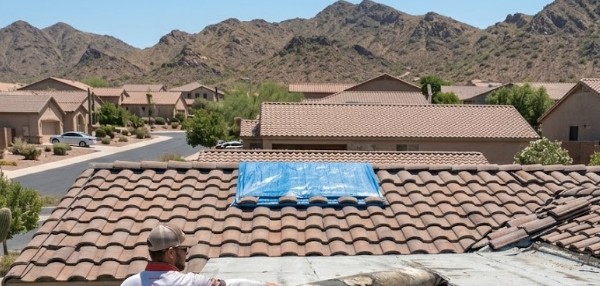
- ✓ A properly installed tarp secured over the damaged area (not stapled or nailed through roofing material)
- ✓ Documentation with photos BEFORE the tarp goes on, showing the underlying damage
- ✓ A note in your claim file stating when temporary mitigation was performed
- ✓ Work that prevents further damage, not work that alters the damage profile
What it should NOT look like:
- ❌ A contractor doing emergency “repairs” that alter the damage before your adjuster inspects
- ❌ Any work billed to your insurance company without your authorization
- ❌ Signing work authorization that includes claim settlement or payment contingencies
- ❌ A contractor doing permanent repair work before the adjuster has inspected
Important: If a contractor shows up wanting to start permanent repair work before your adjuster has inspected, slow down. Temporary mitigation to prevent further water damage is legitimate and necessary in the Arizona heat. Unauthorized permanent repair work performed before adjuster inspection can void portions of your claim.
Think of it this way: your insurance adjuster needs to see the actual damage, not the contractor’s interpretation of it. Let them do their job first.
Be Present for the Insurance Adjuster’s Inspection
When your adjuster arrives — which in active monsoon season may take several days due to claim volume in Scottsdale, Cave Creek, Paradise Valley, Fountain Hills, and the Phoenix area — be present. Walk the property with them. Point out everything you documented. Share your photographs.
During the inspection:
- Walk with the adjuster
- Show them your photos from the first 6 hours
- Point out each area of damage
- Ask them to explain their findings as they go
- Take notes on what they tell you
Who should be present:
- ✓ You (the homeowner)
- ✓ A licensed contractor if you choose to invite one (optional)
- ✗ NOT a contractor conducting the meeting on your behalf
- ✗ NOT a contractor “negotiating scope” without a public adjuster license
What you should NOT do:
- Don’t allow a contractor to conduct the meeting on your behalf
- Don’t let a contractor communicate your claim position
- Don’t allow a contractor to negotiate scope without proper licensing
- Don’t let anyone pressure you into decisions during the inspection
After the inspection:
Ask the adjuster to walk you through the scope of loss document before they leave. Ask:
- What exactly does the scope cover?
- What did they NOT cover, and why?
- What is the next step?
- What is the timeline for a payment determination?
Review Your Policy Before the Adjuster Visits
Locate your homeowners insurance policy right now and review:
- Your deductible amount — Is it $500, $1,000, $2,500? Some Arizona policies carry separate wind or hail deductibles
- Additional living expenses coverage — If damage makes your home uninhabitable, does insurance pay for a hotel and meals?
- Policy requirements for mitigating damage — What does your policy require you to do after a storm?
- Documentation requirements — What does the insurer need from you?
- Exclusions or limitations — Are there specific things NOT covered?
If policy language is unclear: Call your agent (not the claims line) and ask them to explain coverage in plain terms. Write down their explanation. It becomes part of your claim file.
THE TIMELINE: WHAT COMES NEXT
Days 3-7: Receive Your Adjuster’s Scope and Payment
Once your adjuster has inspected, they issue a “scope of loss” — a document listing exactly what damage they found and what they authorized for repair or replacement.
You will receive a payment determination, often as a check. This is typically your insurance’s payment for the approved damage.
Days 7-14: Get Contractor Estimates
Get 2-3 written contractor estimates for the repair or replacement work. Compare each estimate against the adjuster’s scope.
Questions to ask each contractor:
- Does your estimate match the adjuster’s scope exactly?
- Are there items the adjuster approved that you think cost more?
- Are there items the adjuster missed?
- What is your timeline for completion?
- What warranty do you provide on your work?
If There’s a Gap Between Adjuster and Contractors
If legitimate contractors are bidding significantly higher than what the adjuster authorized, you may have grounds to request:
- A re-inspection by your adjuster
- A supplemental claim for additional damage
- An appraisal process (outlined in your policy)
This is when disputes happen — and it’s normal. Don’t panic. Document the differences and request clarification from your adjuster.
When to Consider a Public Adjuster
If the process becomes adversarial — if you feel your insurer is significantly underpaying or wrongly denying a legitimate claim — that is when to consider hiring a licensed public adjuster to represent you.
Important: A public adjuster is NOT your first step. They are your step when negotiation has stalled and you need professional representation. Hiring one early often slows the process down unnecessarily.
WHAT YOU ABSOLUTELY MUST AVOID
❌ Don’t Let a Contractor Handle Your Claim
This is the biggest mistake Phoenix-area homeowners make — from Scottsdale to Cave Creek to Paradise Valley to Fountain Hills to the East Valley. A contractor knocks on your door the day after the storm. They say, “We handle everything with insurance. Just sign here.”
What actually happens:
You sign an Assignment of Benefits (AOB). The contractor now controls your claim. You lose control of the process. The contractor negotiates directly with your adjuster — sometimes aggressively, sometimes misleadingly. You end up in disputes you didn’t start.
This is separate from a public adjuster. A public adjuster is licensed to represent you. A general contractor is not, and should not.
❌ Don’t Sign Contingency Agreements
A contingency agreement says, “We’ll do the work, and you’ll pay us from your insurance settlement.” This ties your payment to the settlement amount, not the actual work quality.
Problems with contingencies:
- Your contractor now has an incentive to inflate their estimate
- Your contractor may pressure you to dispute your adjuster’s decision
- If insurance underpays, you still owe the contractor the full amount
- You lose leverage in negotiations
❌ Don’t Make Permanent Repairs Before Adjuster Inspection
Your roof is leaking. You want to fix it now. I understand the urgency, especially in the Phoenix-area heat where water damage accelerates faster than anywhere else.
However: If you make permanent repairs before your adjuster inspects, you’ve altered the damage profile. The adjuster can’t see what you’re fixing. This gives them grounds to question your claim.
Solution: Make temporary repairs to stop water intrusion. Leave permanent repairs for after inspection.
❌ Don’t Accept the First Adjuster Decision If It Seems Wrong
Adjusters are human. They sometimes miss damage or misunderstand scope. If you have contractor estimates that significantly exceed the adjuster’s authorization, request clarification.
Your options:
- Ask the adjuster to re-inspect specific areas
- Request a supplemental claim
- Use the appraisal process outlined in your policy
- Hire a public adjuster for professional negotiation
KEY TAKEAWAYS: FIRST 72 HOURS AFTER MONSOON ROOF DAMAGE
✓ Don’t go on the roof. It’s dangerous when wet, and you can’t see more from up there. Stay on the ground and document from below.
✓ Document everything within the first 6 hours. Photos taken the day of the storm carry far more weight with insurance than photos taken days later.
✓ Call your insurance company before you call a contractor. Establish the claim first. Then get an independent contractor assessment.
✓ Stay in control of your claim. Don’t sign documents that transfer your claim rights to a contractor. Don’t let contractors negotiate on your behalf.
✓ Be present for the adjuster inspection. Walk the property with them. Point out damage. Ask questions. Don’t disappear and hope for the best.
✓ Temporary protection is okay, permanent repairs can wait. Stop water intrusion, but don’t alter the damage profile before the adjuster sees it.
✓ Get multiple contractor estimates after the adjuster decision. Compare them to the scope. Request clarification if there are significant gaps.
✓ Only hire a public adjuster if negotiation stalls. They’re specialists in claim disputes, not your first step. Use them when you need professional representation in a difficult negotiation.
FAQ: FIRST 72 HOURS AFTER MONSOON ROOF DAMAGE
Q: What if I can’t get my insurance company on the phone immediately?
A: Claim lines get overwhelmed during active monsoon season affecting Scottsdale, Cave Creek, Paradise Valley, Fountain Hills, and the entire Phoenix area. Keep trying, or go online and file your claim through your insurer’s website if that option is available. Get your claim number the same day if possible. If not, document the date and time you attempted to call — insurers understand volume issues during monsoon season.
Q: Do I have to have a contractor present when the adjuster inspects?
A: No. It’s optional. Some homeowners invite a contractor for additional perspective. Others prefer to walk the property alone and understand the adjuster’s findings without pressure. Either way, YOU should be present. Don’t let a contractor represent you.
Q: How long does the adjuster typically take to arrive?
A: In active monsoon season (June-September), it may take 3-7 days in high-volume areas like Scottsdale and Fountain Hills. In light seasons or lower-demand areas, sometimes 1-2 days. Call and ask for an estimated arrival time when you file your claim. This helps you plan.
Q: What if the adjuster’s scope is way lower than contractor estimates?
A: This happens, and it’s frustrating. First, ask the adjuster to explain the difference. Sometimes there’s a legitimate reason (the contractor over-scoped, for example). If the gap is truly significant, request a re-inspection or supplemental claim. That’s what the process allows.
Q: Can I start cleanup immediately, or does that hurt my claim?
A: You can cleanup and mitigate damage — in fact, your policy probably requires it. Just photograph everything FIRST, before you clean up. Document shows the adjuster what you’re cleaning up from.
Q: My roof is 25 years old. Will insurance deny the claim because of age?
A: Age alone is not grounds for denial. If the damage is storm-related, it’s covered. However, if your roof was already leaking before the storm, the insurer might argue that’s a pre-existing condition. The adjuster will make this determination. If you disagree, you have options to dispute it.
Q: Should I accept the adjuster’s payment, or should I dispute it?
A: Don’t accept it immediately if you think it’s wrong. Get contractor estimates first. Compare them to the scope. If there’s a real gap, request clarification or supplemental claim. Then decide whether to accept, dispute, or escalate.
Q: What’s the difference between a supplemental claim and re-inspection?
A: A re-inspection means the adjuster comes back to look at things they may have missed. A supplemental claim is a request to the insurance company to increase the authorization if additional damage is found. Sometimes you need both.
Q: If I hire a public adjuster, do I lose my claim?
A: No. A public adjuster works on your behalf as your representative. However, they typically take 10% of any additional settlement they recover. Use them when you’re stuck in a dispute you can’t resolve yourself — not as a first step.
WHY THE ARIZONA ROOFER APPROACHES THIS DIFFERENTLY
I’ve been roofing in Scottsdale, Cave Creek, Paradise Valley, Fountain Hills, Mesa, Chandler, Gilbert, Apache Junction, Tempe, Queen Creek, and throughout the greater Phoenix area for 40+ years. I’ve seen thousands of monsoon roof damage claims — the ones that got approved quickly and the ones that dragged on.
What I’ve learned:
The homeowners who follow the 72-hour sequence — document, report, assess, protect — end up with faster claim approvals and fewer disputes. The ones who hand the process to a contractor the first day often end up with smaller settlements and delayed repairs.
My role is clear: I assess damage. I provide honest documentation. I give you information to make informed decisions. I don’t handle your insurance claim. I don’t negotiate with adjusters. I don’t pressure you into decisions.
Why this matters: You own the roof. You own the claim. You should stay in control of both.
When to call The Arizona Roofer:
- After a monsoon, for an honest damage assessment
- To understand whether damage is minor or requires immediate attention
- To verify that a contractor’s estimate makes sense
- To get a second opinion before you commit to repairs
- To answer questions about your roof’s condition
We serve the entire greater Phoenix area:
- Scottsdale
- Cave Creek
- Paradise Valley
- Fountain Hills
- Mesa
- Chandler
- Gilbert
- Apache Junction
- Tempe
- Queen Creek
- Surrounding communities
What we don’t do:
- Handle your insurance claim
- Negotiate with your adjuster
- Pressure you into emergency repairs
- Ask you to sign documents transferring claim rights
- Offer to pay your deductible (that’s illegal)
What we DO do:
- Licensed Arizona roofing contractor (ROC
#352286񗵹) - 40+ years of greater Phoenix area experience
- NCCER Master Trainer credentials
- NRCA Subject Matter Expert
- Written damage assessments with photographs
- Honest answers about what you actually need
- 10-year labor warranty on repair work
- Expertise in Scottsdale tile roofs, Paradise Valley residences, Fountain Hills properties, and East Valley homes
DON’T PANIC — ACT DELIBERATELY
The 72-hour window after monsoon roof damage is not about panic. It’s about moving deliberately and in the right order: document → report → assess → protect.
Homeowners across Scottsdale, Cave Creek, Paradise Valley, Fountain Hills, and the Phoenix area who follow that sequence protect both their home and their insurance claim. Homeowners who wait, or who hand the process to a contractor the same day the storm hits, often end up with smaller settlements, delayed repairs, or both.
You own the roof. You own the claim. Act like it.
NEXT STEPS
If a monsoon just hit your Phoenix-area home:
📞 Call The Arizona Roofer: (480) 435-5210
💬 Text: (480) 435-5210
✉️ Email: info@thearizonaroofer.com
🌐 Schedule inspection online: [website link]
Available 24/7 for emergencies. We’ll provide an honest written damage assessment — no contingency agreements, no pressure, no shortcuts.
We serve Scottsdale, Cave Creek, Paradise Valley, Fountain Hills, Mesa, Chandler, Gilbert, Apache Junction, Tempe, Queen Creek, and all greater Phoenix-area communities.