The Arizona Seasonal Survival Guide
TL;DR
Arizona’s roofs age 30-40% faster than the national average due to UV radiation and extreme heat. Consequently, the clear blue sky is deceiving—your roof in Scottsdale, Cave Creek, Paradise Valley, Fountain Hills, Mesa, Chandler, Gilbert, Apache Junction, Tempe, and Queen Creek is under constant pressure from invisible sun damage. However, a seasonal maintenance strategy catches problems before they become expensive. Moreover, spring inspections identify winter wear, summer monitoring prevents monsoon damage, fall cleanouts prevent water intrusion, and winter checks catch thermal stress cracks. Additionally, waiting until you see a leak means thousands in structural damage. Therefore, proactive seasonal maintenance saves 50%+ compared to reactive emergency repairs. Ultimately, property owners who follow this year-round schedule avoid costly replacements while keeping cooling costs low and peace of mind high.
UNDERSTANDING ARIZONA’S ACCELERATED ROOF AGING
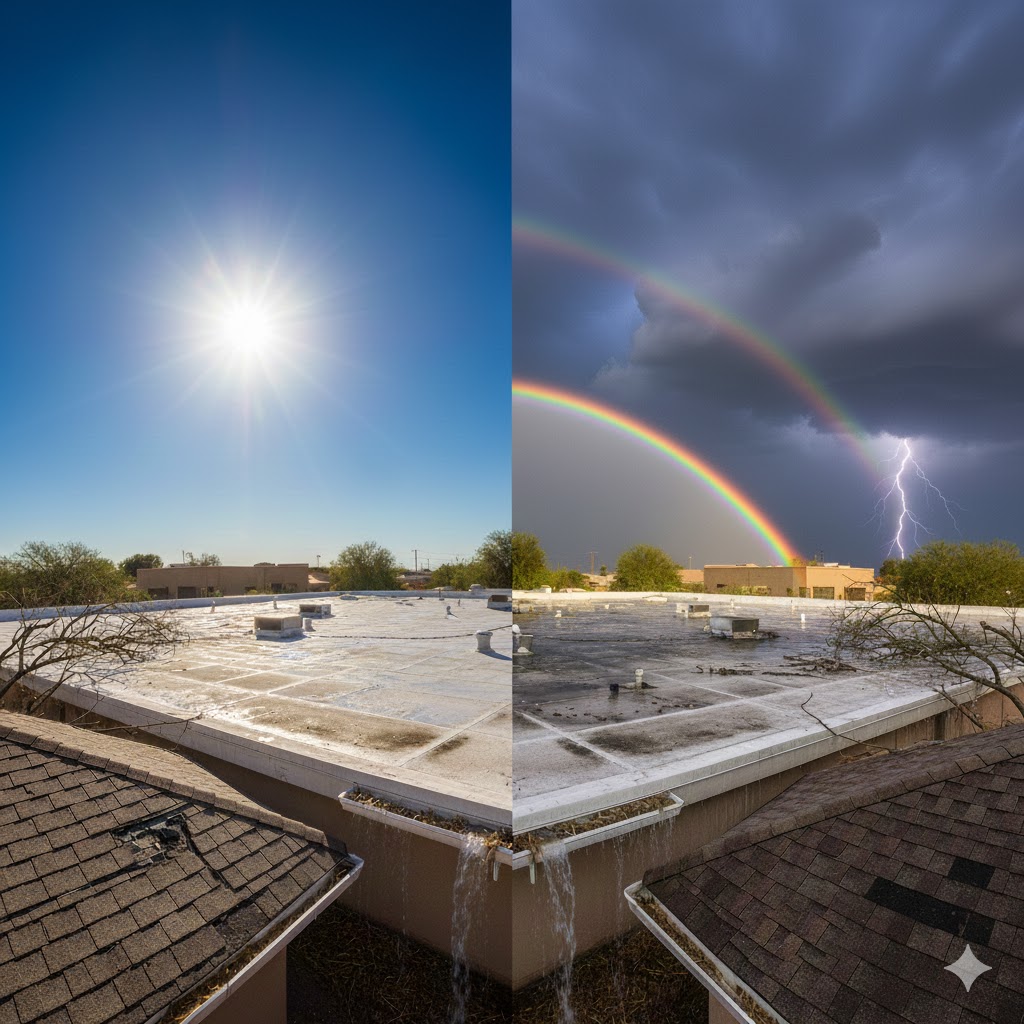
Most property owners assume that if it isn’t raining, their roof is “safe.” However, this assumption is dangerously wrong. Instead, the clear blue Arizona sky is actually a sign of your roof being under constant pressure from UV radiation and extreme heat. Moreover, when the rain finally arrives, it simply reveals the damage that the sun has been doing for months.
According to the Arizona Registrar of Contractors, our roofs age 30-40% faster than the national average due to our unique climate.
Why Arizona is different:
- 300+ days of intense UV radiation per year (vs. 200 nationally)
- Daily temperature swings of 40-55°F creating constant thermal stress
- Elevation near 1,100 feet amplifying UV intensity
- Desert dust accumulation accelerating moisture entrapment
- Low humidity preventing wet areas from drying naturally
The consequence: By the time most property owners see visible damage, significant deterioration is already underway—often requiring costly structural repairs instead of simple maintenance.
WHY SEASONAL MAINTENANCE SAVES THOUSANDS
The biggest mistake property owners make is assuming a roof doesn’t need maintenance until it leaks. By contrast, Arizona contractors know this truth: by the time you see a leak, you are likely looking at thousands of dollars in structural damage and interior repairs.
Proactive maintenance cost: $400-1,000/year
Reactive emergency repairs: $5,000-15,000+
Replacement: $80,000-250,000+
Seasonal maintenance saves 50-70% compared to reactive approaches.
Importantly, each season presents a unique threat. Therefore, skipping even one inspection season can lead to cascading problems.
SPRING: THE PRE-HEAT PREPARATION (MARCH – MAY)
Why Spring Is Your Most Critical Window
Spring is the most critical window for maintenance in Arizona. Additionally, you’re recovering from winter’s cold nights while preparing for the triple-digit “slow cooker” months. Consequently, spring assessment determines whether minor issues become major expenses during summer heat.
Professional Inspection: The Foundation of Spring Maintenance
This is the best time for a full evaluation to catch winter wear and tear before the sun makes it worse. Notably, spring inspections catch problems when they’re still fixable before summer heat accelerates degradation.
What your spring inspection should cover:
✓ Overall roof condition and age assessment
✓ Fastener inspection (nails/screws loose from winter temperature changes)
✓ Flashing integrity around walls, chimneys, and penetrations
✓ Decking and underlayment condition
✓ Attic moisture and ventilation
✓ Tile and shingle condition (cracks, displacement, granule loss)
✓ Coating degradation on commercial flat roofs
✓ Sealant condition around vents and skylights
✓ Gutter and drain system functionality
Cost: $400-800 for comprehensive inspection
ROI: Typically prevents $5,000+ in future repairs
Tile and Shingle Check: Don’t Miss Early Warning Signs
Spring winds can loosen roofing materials. Moreover, examining these carefully now prevents water intrusion later.
What to look for:
- Shifted, cracked, or missing tiles and shingles
- Wind damage from winter storms
- Areas where tiles are beginning to “cup” or curl
- Underlayment visible between tiles
- Granule loss in gutters (sign of material degradation)
Many homeowners confuse cosmetic damage with functional damage. Interestingly, a cracked tile that still provides water shedding is different from a displaced tile that allows water underneath. Therefore, professional assessment distinguishes between these problems.
Trim Your Trees: Prevention Is Easier Than Repair
Arizona trees grow fast in spring. Additionally, trimming now prevents summer damage and keeps branches from scraping your shingles during high-wind events.
Maintenance guidelines:
- Trim branches at least 5-6 feet away from your roof
- Remove dead or diseased branches completely
- Clear overhanging vegetation from gutters and valleys
- Improve ventilation by opening canopy around roof
- Remove branches that touch or scrape roof during wind
Notably, branch damage creates entry points for water intrusion. Furthermore, debris from overhanging trees clogs gutters and traps moisture.
Clear Winter Debris: Don’t Trap Moisture Against Your Deck
Remove the dust, leaves, and pine needles that have settled in your valleys and gutters. Importantly, debris traps moisture and heat against your roof deck—accelerating deterioration.
Spring cleaning checklist:
- Clear all valleys of accumulated debris
- Clean gutters and downspouts thoroughly
- Remove moss or algae growth
- Inspect drain pipes for blockages
- Verify water flows freely away from foundation
- Document debris conditions with photos
For businesses in Mesa, Chandler, Gilbert, and Apache Junction, spring cleanup of flat roof drains is essential. Blocked drains lead to ponding water—adding thousands of pounds of weight and creating premature membrane failure.
SUMMER: THE SUN & MONSOON CHALLENGE (JUNE – SEPTEMBER)
Understanding Summer’s Double Threat
This season is a double-threat for roofs in the East Valley. On one hand, you have the chemical breakdown caused by UV rays. On the other hand, you have the violent mechanical stress of monsoon storms arriving mid-summer.
The summer equation:
- UV degradation constant 24/7
- Thermal stress from 40-55°F daily swings
- Monsoon storm risk (July-September)
- Intense heat (100-120°F+ on roof surfaces)
- Potential hail damage during severe storms
Check Attic Ventilation: The Unsung Hero of Summer Cooling
Proper airflow is the only way to keep your attic from reaching 150°F+, which “cooks” your underlayment and roof deck from the inside out.
Why ventilation matters in Arizona:
An attic reaching 150°F+ in summer doesn’t just feel hot—it actually degrades roofing materials from underneath. Moreover, inadequate ventilation traps moisture, accelerates mold growth, and shortens roof life significantly.
Ventilation assessment:
- Measure attic temperature (should be 20°F below outside temp with proper ventilation)
- Check soffit vents for blockage or debris
- Verify ridge vents aren’t blocked by insulation
- Ensure intake and exhaust are balanced (50-50 rule)
- Look for signs of moisture or mold
- Check insulation condition (not blocking vents)
Notably, many properties in Scottsdale, Cave Creek, Paradise Valley, and Fountain Hills have insufficient ventilation—a legacy of 1990s-2000s construction standards. Improved ventilation can reduce attic temperatures 15-20°F and extend roof life 5-10 years.
Inspect Roof Coatings: Watch For Early Failure Signs
For commercial flat roofs or foam systems, look for “chalking,” blisters, or punctures. Moreover, a healthy coating reflects heat and can lower your AC bills significantly.
What to monitor:
- Chalking: White powdery residue (sign of UV breakdown)
- Blisters: Bubbles in coating (trapped moisture)
- Punctures: Small holes or tears
- Color fading: Loss of reflectivity
- Sealant cracks: Around penetrations and seams
A coating that’s failing (reflectivity dropping from 80% to 30%) increases cooling costs 10-15%. Therefore, maintaining your coating actually pays for itself through energy savings.
Cost-benefit: Coating restoration ($5-12/sq ft) vs. replacement ($15-25/sq ft) saves 40-60% while maintaining energy efficiency.
Post-Storm Quick Checks: Don’t Wait For Visible Damage
After a major dust storm or monsoon, scan your roof from the ground with binoculars. Importantly, look for slipped tiles or “granule loss” in your gutters—both are signs your roof is losing its protective armor.
Post-storm inspection checklist:
Within 6 hours:
- Photograph entire roof from ground level
- Document any visible damage
- Check gutters for debris and granule loss
- Look for displaced tiles or shingles
- Check for water intrusion inside
Within 24 hours:
- Call insurance if damage appears
- Get claim number documented
- Schedule professional assessment
- Don’t allow temporary patches before inspection
Never go on a wet roof—the risk of slipping is extreme in Arizona. Therefore, ground-level photography and binocular inspection provide sufficient damage assessment.
Monitor Drains & Scuppers: The Hidden Catastrophe
For commercial properties in Mesa, Chandler, Gilbert, Apache Junction, and throughout the East Valley, blocked drains lead to “pooling” water. Notably, in Arizona, pooling water can lead to structural collapse because it adds thousands of pounds of weight in minutes.
Why drainage is critical:
- 1 inch of water on 10,000 sq. ft. roof = 600,000 pounds of weight
- Commercial roof decks aren’t designed for sustained water loads
- Pooling water accelerates membrane degradation
- Mosquitoes breed in standing water (health hazard)
- Thermal stress on saturated membrane causes early failure
Summer monitoring protocol:
- After each rain, check for ponding water
- Clear drains and scuppers of debris
- Verify water flows freely within 48 hours of rain
- Check drain pipes for blockages
- Test overflow drains if present
- Document drainage patterns with photos
FALL: THE RECOVERY PHASE (OCTOBER – NOVEMBER)
Why Fall Is About Preparing For Winter
Fall is about undoing the damage the monsoon season left behind and sealing the property before the temperature drops. Moreover, proper fall maintenance prevents winter water intrusion and mold development.
Gutter and Scupper Cleanout: Don’t Leave Debris For Winter
Monsoon storms dump massive amounts of dust and debris into your drainage systems. Furthermore, if you don’t clear them now, winter rains will back up into your fascia and foundation.
Fall cleanup priorities:
Gutters:
- Remove all debris (leaves, dust, pollen)
- Flush with water to verify flow
- Check for debris in downspouts
- Repair any gutter damage or leaks
- Verify proper slope toward drains
Flat roof drains and scuppers (commercial):
- Clear all debris around drains
- Test drain flow with water
- Check for algae or biological growth
- Verify overflow drains function
- Document drain conditions
Cost: $400-800 for comprehensive cleanout
Prevention value: Prevents $5,000+ in water damage
Interior Leak Check: Catch Problems Before Mold Develops
Inspect your ceilings and attic for water stains or musty odors. Moreover, small leaks that started during the monsoons can turn into mold problems during the cooler, humid months.
Interior inspection checklist:
Visual inspection:
- Check all ceilings for water stains
- Look at attic framing for discoloration
- Inspect insulation for moisture or mold
- Check walls near roof penetrations
- Look for active drips or wet areas
Sensory assessment:
- Smell for musty odors (mold indicator)
- Touch insulation for dampness
- Look for visible mold growth
- Check for paint bubbling or peeling
Notably, Arizona’s low humidity means interior moisture problems aren’t always obvious. However, once cooler months arrive and humidity increases, small moisture problems become mold problems quickly.
Reference: EPA: Mold in Homes
Reseal Penetrations: Prevent Winter Water Intrusion
The summer heat often dries out the sealant around your vents, skylights, and chimneys. Importantly, we check for cracks in the caulk and re-apply fresh protection to prevent winter leaks.
Penetrations to inspect:
- Plumbing vents (1-2 per home typical)
- HVAC exhausts and return air penetrations
- Chimney flashing and cap
- Skylights and dome windows
- Satellite dishes and antennas
- Solar panel penetrations (increasingly common)
Sealant assessment:
- Check for cracks or gaps
- Look for separation from flashing
- Verify sealant is flexible (not hardened)
- Assess color and weathering
- Test adhesion (should not pull away easily)
Use sealants rated for Arizona’s UV intensity. Standard caulks fail within 12-18 months.
Cost: $50-200 per penetration for professional resealing
Prevention value: Prevents $1,000+ in water damage per leak
WINTER: THE CYCLE OF STRESS (DECEMBER – FEBRUARY)
Understanding Winter’s Thermal Shock Problem
While we don’t get much snow in the Valley, we do get “Thermal Shock”—the constant expansion and contraction of materials as we move from hot days to freezing nights. Moreover, this daily cycling creates stress that loosens fasteners and compromises seals.
Winter temperature patterns in Arizona:
- Daytime temps: 60-75°F
- Nighttime temps: 35-50°F
- Daily swings: 20-30°F+
- Duration: 60-90 days of cycling
This daily breathing creates cumulative stress on every roof component—especially critical for properties in Scottsdale, Cave Creek, Paradise Valley, Fountain Hills, and higher-elevation East Valley locations.
Freeze-Thaw Inspection: Catch Thermal Stress Damage
This daily cycle can pop nails and loosen flashing. Importantly, we check that your metal transitions are still watertight.
Thermal stress inspection:
Fastener check:
- Scan for protruding or loose nails
- Look for “nail pops” (nails backed out)
- Check screw fasteners for backing out
- Verify fasteners hold material snugly
Flashing assessment:
- Check metal flashing for separation
- Look for gaps opening up at transitions
- Verify sealant at flashing edges
- Check for bent or warped metal
Notably, fasteners backing out create water entry points. Furthermore, loose flashing allows water underneath. Therefore, winter fastener failure directly causes spring water intrusion.
Insulation Review: Maintain Thermal Efficiency
Ensure your attic insulation hasn’t shifted or been compressed. Moreover, good insulation keeps your home’s heat inside and away from your roof deck.
Insulation assessment:
- Verify insulation covers entire attic (no gaps)
- Check for compression or settling
- Look for moisture damage or mold
- Verify R-value is adequate
- Check ventilation isn’t blocked by insulation
Winter provides ideal conditions to inspect insulation without extreme heat. Furthermore, inadequate winter insulation affects both heating costs AND summer cooling efficiency.
Commercial Asset Check: Plan Spring Restoration Projects
Winter is the ideal time for commercial managers to plan for larger restoration projects in the spring. Additionally, contractors’ schedules are often more flexible in winter, potentially offering better pricing.
Winter planning checklist:
- Review roof condition assessment from previous inspections
- Prioritize repair vs. restoration vs. replacement options
- Obtain multiple contractor estimates
- Check contractor licensing and references
- Plan for tenant notifications and scheduling
- Budget for spring projects
- Consider energy efficiency improvements
Interestingly, scheduling restoration work in spring (March-May) before summer heat arrives ensures optimal application conditions and material curing.
COMMON QUESTIONS: SEASONAL MAINTENANCE IN ARIZONA
Q: Do I really need seasonal inspections? Can I just inspect once per year?
A: Annual inspections miss critical problems. Therefore, seasonal inspections catch damage at the optimal time for repairs.
Why seasonal timing matters:
- Spring catches winter damage before summer accelerates it
- Summer monitoring prevents monsoon catastrophes
- Fall prevents winter water intrusion
- Winter identifies thermal stress cracks
Moreover, Arizona’s extreme climate changes dramatically season-to-season. Consequently, damage visible in one season may be hidden in another.
Q: How much does a seasonal inspection cost?
A: Professional inspections typically cost $400-800 each. However, they often prevent $5,000-15,000+ in emergency repairs.
Consider the ROI:
- Annual inspection cost: $1,600-3,200 (4 seasonal inspections)
- Typical emergency repair: $8,000-20,000
- One prevented emergency repair pays for 3-5 years of inspections
We offer low monthly payment plans so you can fix minor issues before they become major expenses.
Q: My roof hasn’t leaked yet. Do I still need seasonal maintenance?
A: This is the #1 mistake Arizona property owners make. By the time you see a leak, significant structural damage often exists already.
Consider this timeline:
- Year 1-3: Invisible UV degradation beginning
- Year 3-5: Micro-fractures developing (no visible signs)
- Year 5-7: Sealants cracking (still no leaks visible)
- Year 7-10: Water intrusion begins (NOW you notice)
- Year 10+: Structural damage, mold, expensive repairs
Smart approach: Catch problems at year 3-5 through seasonal inspections, not at year 10 through emergency repairs.
Q: What’s the difference between preventive maintenance and seasonal maintenance?
A: Preventive maintenance is general upkeep (clearing gutters, checking sealants). Seasonal maintenance is strategic inspection timed to catch problems specific to each season’s challenges.
Seasonal strategy includes:
- Spring: Winter damage assessment before summer acceleration
- Summer: UV and monsoon damage monitoring
- Fall: Moisture prevention before winter humidity
- Winter: Thermal stress identification
Moreover, seasonal maintenance is more cost-effective because it addresses problems at the optimal time for repair—before they cascade into bigger issues.
Q: Can I do seasonal maintenance myself, or do I need a professional?
A: DIY inspection catches obvious problems but misses critical issues.
What professionals catch that homeowners miss:
- Micro-fractures in coatings (invisible without close inspection)
- Underlayment degradation (requires lifting materials)
- Thermal imaging to detect moisture (requires equipment)
- Structural integrity assessment (requires expertise)
- Sealant condition detailed analysis
- Ventilation sufficiency calculations
Professional inspections every 2-3 years, supplemented by seasonal homeowner checks (visual scan, gutter clearing, debris removal) provide the best protection.
NEXT STEPS: START YOUR SEASONAL MAINTENANCE PROGRAM
Don’t wait until you see visible damage to protect your property. Moreover, seasonal maintenance is the single most effective way to extend roof life while minimizing costs.
Get started with a spring inspection:
📞 Call The Arizona Roofer: (480) 435-5190
📱 Text: (480) 435-5190
📧 Email: thearizonaroofer@gmail.com
🌐 Website: www.thearizonaroofer.com
What we provide:
✓ Complete seasonal inspection with written report
✓ Photographs and thermal imaging documentation
✓ Prioritized recommendations (immediate, 6-month, 12-month)
✓ Cost estimates for recommended work
✓ Scheduling for follow-up seasonal inspections
✓ Financing options for repairs and maintenance
✓ Warranty documentation for all work performed
We serve the entire East Valley:
Scottsdale • Cave Creek • Paradise Valley • Fountain Hills • Mesa • Chandler • Gilbert • Apache Junction • Tempe • Queen Creek
Licensed, Bonded, Insured:
ROC #352286 & #359801 | 40+ Years Arizona Experience
Financing Available:
Low monthly payment plans | Section 179 tax deductions (commercial) | Flexible payment options